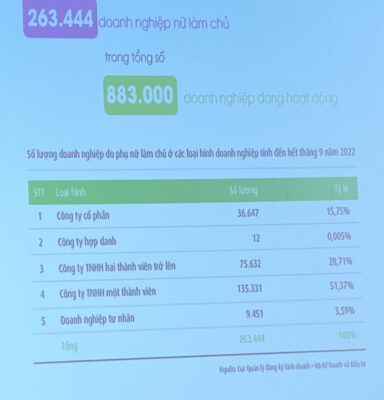
Number of Women-Owned Businesses as of September 2022
Notably, the research results from the VCCI research team indicate that although women-owned businesses faced more difficulties due to the impact of Covid-19 compared to men-owned businesses, the rate of employee layoffs was lower in women-owned businesses than in men-owned businesses. “This shows the clear humanistic culture in women-owned businesses,” said Mr. Tuấn.
The survey results also showed that in 2021, most (93.9%) women-owned businesses reported being negatively affected by Covid-19, a rate similar to that of men-owned businesses at 93.7%. Meanwhile, only 4.9% of women entrepreneurs were unaffected, and 1.2% believed Covid-19 had a positive impact. The main challenges faced by women entrepreneurs due to Covid-19 were access to cash flow and customers, supply chains, and human resources.

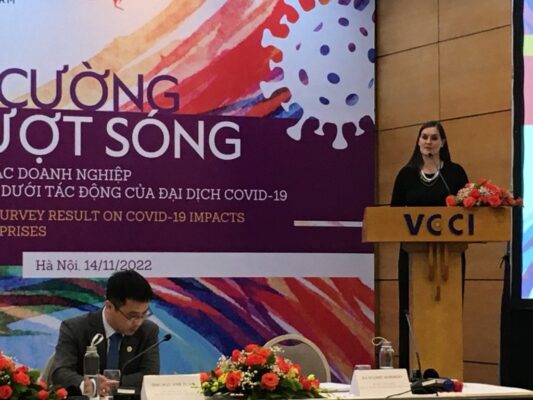
Ms. Majdie Hordern, First Secretary of the Australian Embassy in Vietnam, Suggested that the Vietnamese Government Design a More Suitable Support Package for Women-Owned Businesses
Efforts to “Ride the Waves” Without “Losing Control”
Sharing at the workshop, Ms. Đinh Hoàng Giang, CEO of Seconin Building Materials JSC, stated that Covid-19 had a significant impact on the business community, including women-owned businesses, especially during the period of social distancing. This affected their production and business activities.
Even when Covid-19 was under control and business production nearly returned to normal, in 2022, businesses faced another challenge: global inflation and the energy crisis, which impacted logistics costs.
“Previously, an export container to the US cost only 5,000-6,000 USD, but when inflation and fuel prices rose, it increased to 15,000 USD. Moreover, there were no empty containers available for shipping, causing product costs to skyrocket and customer demand to plummet,” Ms. Giang explained.
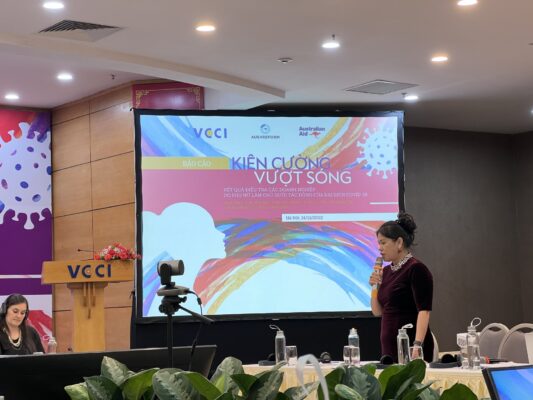
Ms. Đinh Hoài Giang, CEO of Seconin Building Materials JSC, Speaking at the Workshop
Regarding the Japanese market, shipping costs have not increased too much; previously it was 200 USD per container, and now it is 500 USD. “However, we are facing the devaluation of the Yen. The number of orders from the Japanese market has dropped significantly in 2022 due to inflation and the Yen’s 30% devaluation,” Ms. Giang added.
“We believe that a business is like a boat; if it encounters big waves and just sits still, it could be submerged or left behind. Therefore, the company always seeks ways to adapt to adversity, enhance digital transformation, and search for new markets to ride the waves,” Ms. Giang shared her company’s experience in overcoming the crisis.
Similarly, Ms. Nguyễn Thị Ánh Tuyết, CEO of Nhật Hải Company, noted that while Covid-19 is basically under control, global inflation and economic recession are greatly affecting the production and business activities of the business community, including women-owned businesses.
She stated that to get through this turbulent period, besides the support policies from the authorities, businesses themselves need to restructure costs and products to focus on key products, aiming to increase profits and overcome difficulties.
Ms. Bùi Thị Hạnh Hiếu, CEO of Bảo Minh Agricultural Processing JSC, shared her experience in “riding the waves” of the crisis. According to her, the most important factor is the owner’s resilience. In difficult times, it is crucial to remain calm, steer the ship through the waves, and choose the right direction for the company.
Ms. Bùi Thị Hạnh Hiếu, CEO of Bảo Minh Agricultural Processing JSC
Need for Proactive Access to Support Packages
According to Ms. Nguyễn Thị Tuyết Minh, Chairwoman of the Vietnam Women Entrepreneurs Council, women-owned businesses still face many difficulties and challenges, especially in the context of the Covid-19 pandemic. To provide opportunities for businesses to overcome these challenges, the government and various ministries have introduced many support packages for women-owned businesses, but not all businesses have been able to access them.
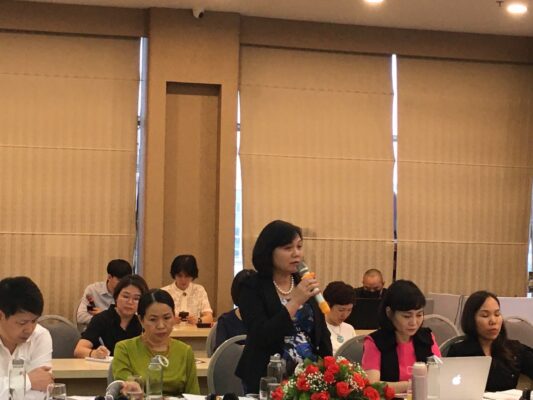
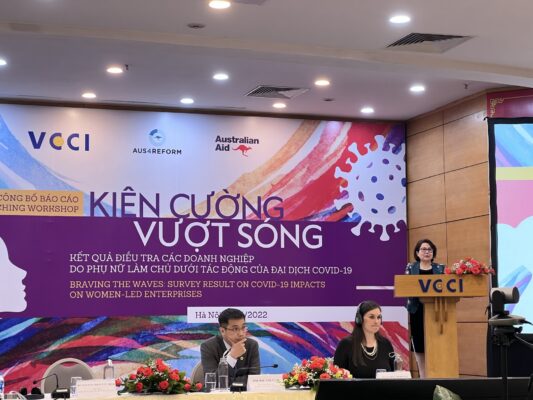
**Chairwoman of the Vietnam Women Entrepreneurs Council, Nguyễn Thị Tuyết Minh, at the Workshop**
“Therefore, to overcome difficulties, women-owned businesses need to be more proactive in accessing support packages. Along with this, business associations nationwide need to be more proactive in accessing information and designing practical policies to support member businesses through specific activities, including women-owned businesses,” Ms. Minh proposed.
The VCCI research team suggested that local authorities should prioritize women-owned businesses in their support programs across all regions, ensuring equal access to credit for these businesses, especially after the State Bank officially eased credit growth targets for some commercial banks. Simplifying loan conditions and procedures and expediting the processing of applications were also recommended. Ms. Phan Minh Thủy, a representative of the VCCI research team, emphasized that the government should set appropriate goals for each period to develop fiscal support packages of sufficient scale to meet timely, targeted, and comprehensive criteria, bringing about the expected effectiveness.
Relevant agencies can work with business associations and other business networks and communities to provide information, support, and specific guidance on support solutions tailored to the characteristics of the businesses, thus promoting effective access to and utilization of the support measures.
In the short term, the objective of the fiscal support packages is to control the pandemic and minimize health and economic impacts, so priority will need to be given to healthcare spending, ensuring social security for the population and workers, and supporting the business sector, particularly in industries with widespread effects and those capable of rapid recovery post-pandemic. Small and medium-sized enterprises, in particular, still play a crucial role in direct grants.
In the long term, with the goal of supporting economic recovery, fiscal measures during this phase should gradually shift from direct to indirect support, from financial to regulatory support, and from supporting a large number of subjects to focusing on those still experiencing long-term impacts from the pandemic. The aim is to promote innovation, digital transformation, and sustainable green growth.
Business associations, clubs, and representative organizations should strengthen activities to support business connections and market expansion for their members. Simultaneously, businesses need to proactively find ways to “save themselves,” such as online business, virtual exhibitions, and participating in online trade and connection events.
Government agencies and business associations should provide timely market information; businesses should be more proactive in controlling and minimizing market volatility risks by assessing risks and planning responses, such as expanding sales channels, broadening supply chains, and strengthening distribution channels.
Source: According to Economic Forecast and Analysis.