


What businesses need to consider when the EU emphasizes green standards
The European Union (EU) is increasingly focusing on green standards in the food sector. Alongside the opportunities it brings, Vietnamese businesses are advised to pay attention to regulations to meet the export standards to this market.
On the afternoon of November 25th, the Export Support Center, the Trade Promotion Agency under the Ministry of Industry and Trade, organized a seminar “Promoting the Export of Vietnamese Agricultural Products to the European Market,” aiming to provide information on the potential and advantages of Vietnamese agricultural products when penetrating the EU market. The seminar also provided information on trends and green, clean, and environmentally friendly standards suitable for EU’s general regulations to Vietnamese businesses.
According to Deputy Director of the Export Support Center Nguyen Thi Thu Thuy, Europe is a large and important agricultural export market for Vietnam. Recently, agricultural exports to this market have shown significant growth. Some product groups such as rice, vegetables, and fruits have had impressive growth.
“In the current context, technical barriers to Vietnamese agricultural trade with Europe continue to increase. Therefore, businesses need to be proactive in grasping market information, changing their mindset, and awareness to adapt to market requirements,” said Thuy.
Green food trends in Europe
The European Green Deal is one of the issues that Vietnamese export businesses need to pay attention to. According to Commercial Counselor of the Vietnam Trade Office in Belgium and the EU Tran Ngoc Quan, since 2019, the EU has launched the European Green Deal (EGD). The EGD is a set of policy initiatives put forward by the European Commission to reduce greenhouse gas emissions and minimize resource use while achieving economic growth. This implies that products sold in the EU market need to meet higher sustainability standards.
Among the core provisions of the EGD, the Farm to Fork strategy stands out (a fair, healthy, and environmentally friendly food system).
The Farm to Fork strategy aims to reduce by 2030: the use and risk of chemical pesticides by 50%, nutrient losses by at least 50%, fertilizer use by at least 20%, antibiotic sales for farm animals by 50%, and 25% of agricultural land to be converted to organic production…
To ensure fairness, the EU will move towards requiring other countries to implement similar measures, or else they will impose environmental taxes.
“The Farm to Fork strategy is a topic that businesses need to seriously study when they want long-term access to the EU market,” Quan stated.
In addition, the EU is planning to achieve the ambitious goal of becoming climate-neutral by 2050. However, EU businesses may relocate carbon-intensive production activities overseas to take advantage of looser standards, also known as “carbon leakage.”
To prevent this risk, the EU has decided to balance carbon prices between domestic and imported products through the Carbon Border Adjustment Mechanism (CBAM). CBAM will impose a carbon price on imported goods based on the greenhouse gas emissions intensity of the production process.
Opportunities for Vietnamese businesses
Given the above situation, according to Counselor Trần Ngọc Quân, major importers in Europe will be responsible for ensuring that products entering the EU market comply with the principles of the Green Deal. Therefore, importers are willing to support exporting businesses in transitioning to more sustainable processing and production practices.
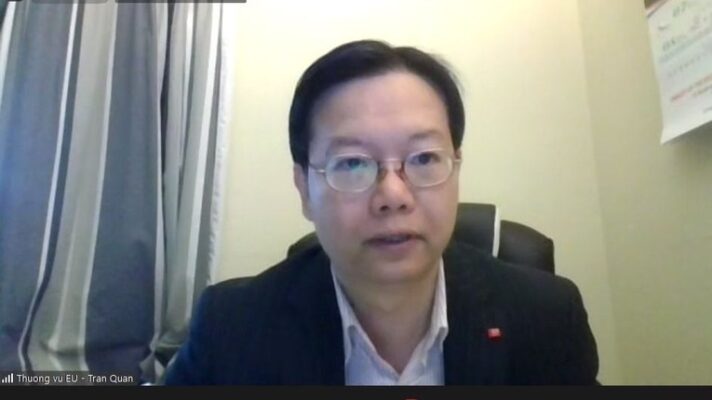
Commercial Counselor of the Vietnam Trade Office in the EU and Belgium Tran Ngoc Quan
“The EU is establishing support programs, particularly targeting small and medium-sized enterprises, to transition to compliance with the new EU Green Deal regulations. Better tools and mechanisms will be introduced to provide information about businesses’ products and improve processing and production activities.”
Many policies and measures of the EGD are built upon existing regulations that businesses may already be complying with if they are currently exporting to Europe. Sustainability in industrial processes not only provides businesses with opportunities to operate in Europe but can also offer a competitive advantage on the international stage.
Recommendations for Vietnamese businesses
Given the above situation, according to Counselor Tran Ngoc Quan, the immediate impact of the Farm to Fork strategy on export businesses to Europe is the New Common Agricultural Policy, which will take effect in the first quarter of 2023. Export businesses to the EU will have to adhere to stricter labeling and information regulations, use fewer chemical pesticides and fertilizers, and provide better living conditions for livestock.
Rules on “labeling” in the new regulations of organic organizations will not only include labels on products but also apply to all statements, instructions, trademarks, trade names, images, or signs related to a product on packaging, documents, signs, labels, loops, or bands accompanying or referring to that product.
Only terms such as organic and ecological (or shorter terms like ‘biological’ and ‘ecological’) can be used if the product is certified organic. Manufacturers should note that the design of product packaging should not be too similar to the colors (green and white) and shape (leaves) of the EU Bio emblem, as this could lead to consumer misunderstanding that the product is organic.
Labels for organic products entering the EU market must include the registration number of the controlling body to which the manufacturer is subject and the location where the agricultural raw materials from which the product is made were grown.
Source: Mekong ASEAN
Related news

SIC Mart (Social Impact Creation Mart) bridges business and social impact.
SIC Mart (Social Impact Creation Mart) is a unique e-commerce platform, not just an ordinary shopping hub but also a bridge between business and social impact, a social impact business ecosystem where enterprises not only pursue profits but also focus on creating value for society. Initiated by the Vietnam Manpower Development Company Integration in 2023, […]

SEACO and the Hanoi Association of Women of Small and Medium Enterprises (HAWASME) had a visit to the Vietnamese Embassy in Laos.
On November 3, 2022, Dr. Dương Thị Kim Liên, Director of the Institute for Business Innovation Assistance (IBIA) and Deputy Director of Seaconsult Joint Stock Company, along with a delegation from the Small and Medium-sized Women Entrepreneurs Association of Hanoi, paid a visit to the Vietnamese Embassy in Laos. The event was attended by the […]

Women-owned businesses under the impact of the covid-19 epidemic
“Covid-19 has significantly impacted the business community, including women-owned enterprises, especially during periods of social distancing. This has affected their production and business activities. On the afternoon of November 14, the Vietnam Chamber of Commerce and Industry (VCCI) held a workshop to announce the report ‘Resiliently Overcoming the Waves: Survey Results of Women-Owned Businesses Under […]